
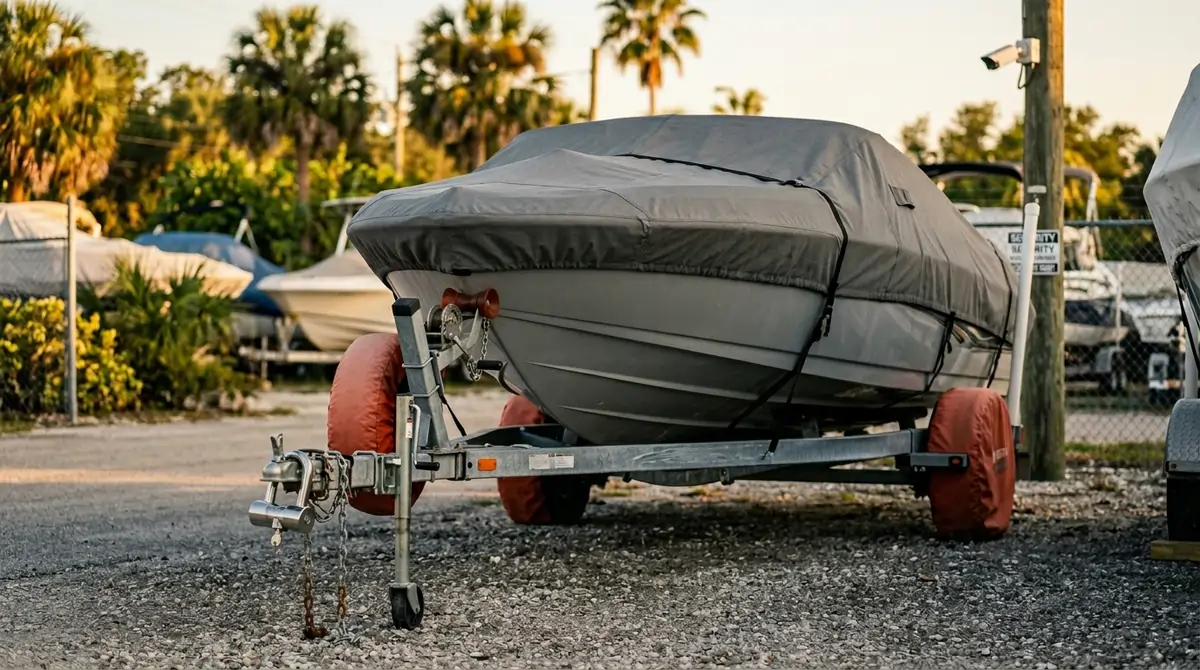
How to Protect Your Boat in Storage: A Complete Guide
Storing a boat is not a passive activity. From the moment you haul out to the moment you launch again, your vessel faces an ongoing set of threats — UV radiation, moisture, corrosion, pests, fuel degradation, and opportunistic theft. Understanding each threat and applying targeted protection is what separates a boat that comes out of storage in pristine condition from one that needs significant work before it’s seaworthy again.
This guide is organised around the specific threats your boat faces during storage, with clear, practical protection measures for each one. We’ve written it specifically for boat owners in the Jacksonville, FL area — where Florida’s climate, salt air, and hurricane season create a more demanding storage environment than most guides account for.
1. The six threats your boat faces in storage
Most boat owners focus on one or two storage risks while overlooking the others. Understanding all six — and how they interact — allows you to protect your boat comprehensively rather than patchwork.
Florida’s UV Index regularly hits 10–11 (Extreme) in summer. Degrades gel coat, vinyl, rubber seals, tyre sidewalls, and plastic fittings faster than any other climate in the continental US.
Jacksonville humidity averages 80%+ year-round. A sealed boat in Florida heat becomes a mould incubator within weeks. Also causes structural water damage when rain pools inside the hull.
Salt air and residual salt water in the engine, hardware, and electrical systems cause rapid corrosion even in storage. Galvanic corrosion on dissimilar metals accelerates without regular treatment.
Year-round warmth means rodents, cockroaches, wasps, and ants are active throughout storage. A single mouse colony causes more damage than a year of UV exposure — chewing wiring, upholstery, and hoses.
Ethanol-blended fuel left untreated in Florida’s heat undergoes phase separation and varnishes carburettors and fuel injectors. Fuel stabiliser is inexpensive insurance against an expensive repair.
Boats stored in unsecured or poorly monitored locations are targets for theft of electronics, outboard motors, and the vessel itself. The right facility and simple physical deterrents address this effectively.
2. Protecting your boat against UV damage
UV protection requires a layered approach — a single measure isn’t sufficient in Florida’s extreme UV environment. Think of it as sunscreen: you need more than one thin layer on a full Florida summer day.
Layer 1: Wax all gel coat surfaces
Apply a UV-inhibiting marine wax to every fibreglass surface before fitting the cover. Even under a cover, UV can penetrate — and if the cover shifts, bare gel coat is exposed. Wax provides the base layer of UV protection and also makes post-storage cleaning significantly easier.
Layer 2: UV protectant on all rubber, vinyl, and plastic
Apply 303 Aerospace Protectant or a comparable UV protectant to all rubber seals, vinyl upholstery (even if removed), plastic trim, steering wheel, and window frames. These materials absorb UV protection products and resist degradation significantly longer than untreated surfaces.
Layer 3: Quality UV-rated cover
The cover is your primary UV shield. It must be rated for UV protection — not just weather resistance — and must be made from breathable material. A cover rated to block 95%+ UV radiation from a reputable marine brand (Taylor Made, Carver, Westland) is worth the investment for any boat stored outside in Florida.
Layer 4: Individual component covers
Use dedicated covers for the compass, helm instruments, chartplotter, and VHF radio — even under the main cover. Electronics are particularly UV-sensitive and a $15 instrument cover extends their life by years in Florida’s storage environment.
3. Protecting your boat against moisture and mould
Moisture is the most complex storage threat because it comes from multiple sources simultaneously — rain, condensation, humidity, and standing bilge water — and causes multiple types of damage: mould growth, structural delamination, electrical corrosion, and upholstery degradation.
Eliminate standing water before storage
Remove the drain plug and pump the bilge completely dry. Flush all livewells, bait wells, and fish boxes with fresh water and allow to drain and air-dry completely. Any standing water left in the boat before storage will become a mould and odour problem within weeks in Florida’s heat.
Manage interior humidity actively
Place DampRid hanging moisture absorber bags throughout the interior — one in the cabin, one in the head, one in any enclosed storage compartments. These work by pulling moisture from the air into a crystalline absorber that fills over 4–8 weeks in Florida’s humidity. Check and replace them on your monthly inspection visits.
Create ventilation without creating exposure
A completely sealed boat becomes a humidity trap — but an open boat is exposed to rain, debris, and pests. The solution is ventilation while maintaining protection: crack the forward hatch using a purpose-built vent insert or a small louvred hatch cover. Leave all internal compartment doors and lids open to allow air to circulate around all upholstery and surfaces.
Professional mould remediation on boat interiors — particularly in upholstery, cushions, and headliner — can cost $500–$2,000+ depending on the extent. Prevention costs under $30 in moisture absorbers and 20 minutes of your time. In Florida’s climate, the prevention investment pays for itself every single storage season.
Cover design and water runoff
Your boat cover must shed rain actively — not pool it. Install a centre support to create a tent-like peak so water runs off the sides. After any significant rain, check the cover for pooling and remove water if present. A custom-fit cover with built-in vents handles both the water and the ventilation requirements in one product.
4. Protecting against corrosion
Corrosion affects every metal component on your boat during storage — the engine, hardware, electrical connections, and trailer. In Jacksonville’s salt air environment, corrosion proceeds even when the boat isn’t in the water.
Engine corrosion protection
Fogging oil sprayed into engine cylinders through the spark plug holes or into the air intake while running creates a protective oil film on cylinder walls, crankshaft, and valve components. This is standard procedure for storage over 30 days and prevents the dry-start wear that shortens engine life significantly over multiple storage seasons.
After flushing the cooling system with fresh water, apply a corrosion inhibitor spray (Corrosion Block, Boeshield T-9, or similar) to all engine electrical connections, the carburetor or throttle body, and the starter motor. These products displace water and form a protective barrier against salt air.
Electrical system protection
Every electrical connector, terminal, and junction in a marine electrical system should be treated with dielectric grease or a dedicated marine electrical contact protectant before storage. Pay particular attention to the main battery terminals, engine wiring harness connectors, trailer light plugs, and any through-hull electrical connections. Salt air corrodes electrical contacts rapidly — a corroded connection causes intermittent faults that are frustrating and time-consuming to diagnose.
Hardware and fittings
Stainless steel is corrosion-resistant — not corrosion-proof. Clean all stainless hardware with a dedicated stainless cleaner and apply a protectant. Anodised aluminium components should be cleaned and treated with a corrosion inhibitor. Bronze seacocks and through-hulls should be greased with waterproof marine grease before storage.
Sacrificial zinc or aluminium anodes on your engine, outdrive, and hull protect metal components from galvanic corrosion. Anodes that are 50% or more depleted should be replaced before storage — they continue to function during the storage period as the boat sits in salt air. Anodes are inexpensive; replacing corroded metal components is not.
5. Protecting your boat against pests
In Florida’s year-round warm climate, pest protection is a storage-long commitment, not a one-time step. Cockroaches, rodents, wasps, and ants are all capable of causing serious damage to stored boats — and they’re all active throughout the year in Jacksonville.
Seal every entry point
Inspect the entire boat for gaps and openings larger than ¼ inch — mice can enter through a gap the diameter of a pencil. Common entry points include: cable entry points through the transom, the bilge pump outlet, any gap in the engine cowling, and gaps around the windshield frame. Seal these with marine-grade expanding foam or closed-cell foam tape.
Remove every food source and scent
Remove all food, drink, bait, and scented products from the boat completely. Check the bilge for any accumulated fish blood, bait residue, or food waste — these are powerful attractants. Even empty food wrappers or a fishing lure bag with a residual scent will attract ants and cockroaches. Clean the boat obsessively before storage.
Active deterrents that work in Florida
Rodents have an aversion to strong peppermint scent. Place peppermint oil-soaked cotton balls in the bilge, under seats, and in storage compartments. Replace every 4–6 weeks as the oil evaporates.
Apply roach bait gel (Advion or similar) in exterior storage compartments and along the bilge. Gel bait is more effective than spray in marine environments — it remains active for weeks and doesn’t dissipate like aerosol.
Place snap traps in the bilge and any enclosed storage areas as a precaution. Check on your monthly visits. Do NOT use poison bait — a rodent that dies inside your boat walls creates a far worse problem than the one you’re preventing.
Widely reported to deter both rodents and insects when placed throughout the interior. Cheap, non-toxic, and easy to replace. Use in conjunction with other deterrents — not as the sole pest prevention measure.
6. Protecting your boat’s fuel system
Fuel system damage is among the most expensive and most preventable storage damage. Untreated ethanol-blended fuel in Florida’s summer heat undergoes phase separation — the ethanol separates from the petrol and sinks to the bottom of the tank as a water-ethanol mixture. This mixture is corrosive to aluminium fuel system components and will damage carburettors, injectors, and fuel pumps.
The non-negotiable steps
- Fill to 95% capacity: Reduces the air space that allows condensation and fuel degradation. Leave a small expansion allowance — don’t completely fill.
- Use an ethanol-specific marine stabiliser: Star Tron Enzyme Fuel Treatment or STA-BIL 360 Marine are formulated specifically for ethanol-blended fuel. Generic automotive stabilisers do not prevent ethanol phase separation.
- Run the engine after adding stabiliser: Circulates treated fuel through all fuel lines, the filter, and the carburettor or injectors. 10–15 minutes at idle is sufficient.
- For carburettor engines stored over 6 months: Consider draining the carburettor float bowl completely after the final run — this eliminates any residual untreated fuel in the most corrosion-sensitive component.
7. Protecting your boat against theft and vandalism
Boat theft is more common than many owners realise — particularly theft of outboard motors, electronics, and accessories from boats in storage. A layered approach to security addresses both opportunistic and determined theft.
- Choose a facility with genuine security: 24/7 CCTV with coverage of all storage areas, keypad-controlled gate access, perimeter fencing, and lighting throughout the lot. The facility’s infrastructure is your primary protection layer.
- Trailer coupler lock: Prevents the boat being connected to a tow vehicle without the key. This is the most effective single deterrent for trailer boat theft — it stops the most common theft method entirely.
- Outboard motor lock: A dedicated outboard motor lock (Yamaha, Honda, and aftermarket options are available) prevents the motor from being tilted, removed, or started without the key. Outboard motors are high-value theft targets.
- Remove all electronics: Chartplotters, fishfinders, VHF radios, and stereo equipment should be removed and stored indoors during any storage over 30 days. These are the items most commonly targeted in boat break-ins.
- Photograph and document: Maintain current photographs, serial numbers, and a full inventory of installed equipment. In the event of theft, this documentation is essential for insurance claims and police reports.
8. How your storage facility protects your boat
The choice of storage facility is itself a major protection decision. A quality facility provides environmental and security protection that no amount of individual preparation can fully replicate.
Continuous camera coverage of all storage areas deters theft and vandalism, and provides evidentiary footage if an incident occurs. Ask specifically about camera coverage of the area where your boat will be stored — not just the entrance.
A unique access code per customer creates an access log and prevents random public access. Ask whether the facility monitors after-hours entries and whether access codes are changed periodically.
A well-maintained, well-drained lot protects your trailer from corrosion and prevents your boat sitting in standing water after rain. Ask about the surface material and how the lot drains during heavy rain.
A facility that is outside FEMA flood zones and not in a low-lying area provides the best hurricane and storm surge protection. This is a non-negotiable consideration for any Jacksonville boat owner.
Easy access from a major highway reduces the road stress on your trailer and boat for every retrieval and return. A facility near I-95 means less time manoeuvring through suburban streets with a wide boat trailer.
A facility with wide lanes and generous turning spaces reduces the risk of accidental collision with fencing, other vehicles, or other stored boats during manoeuvring — a surprisingly common source of storage damage.
9. Recommended protection products for Florida boat storage
These are the specific products that consistently perform in Florida’s demanding storage environment — not generic recommendations, but products with a track record in salt air, high UV, and high humidity conditions.
- UV protectant: 303 Aerospace Protectant — the industry standard for marine rubber, vinyl, and plastic UV protection
- Marine wax: Collinite 885 Fleetwax or 3M Marine Ultra Performance Paste Wax — both provide UV-inhibiting protection and durability
- Fuel stabiliser: Star Tron Enzyme Fuel Treatment (specifically formulated for ethanol-blended marine fuel) or STA-BIL 360 Marine
- Corrosion inhibitor: Corrosion Block or Boeshield T-9 — displaces salt water and creates long-lasting corrosion barrier on metal surfaces
- Engine fogging oil: WD-40 Specialist Motor Engine Fogging Oil or Sea Foam Motor Treatment — specifically formulated for long-term cylinder wall protection
- Battery maintainer: NOCO Genius or Battery Tender Plus — smart chargers with temperature compensation suitable for Florida’s summer heat
- Moisture absorber: DampRid Hanging Moisture Absorber — designed specifically for enclosed spaces, lasts 4–8 weeks in Florida humidity
- Pest deterrent: Grandpa Gus’s Rodent Repellent pouches — DEET-free, peppermint-based, effective for marine storage environments
10. Complete boat protection checklist
UV protection
- Apply UV-inhibiting marine wax to all gel coat surfaces above waterline
- Apply 303 Aerospace Protectant to all rubber, vinyl, and plastic trim
- Fit UV-rated breathable cover with centre support for rain run-off
- Fit individual covers on compass, helm instruments, and electronics
Moisture and mould protection
- Remove drain plug before storage
- Clean and dry bilge completely
- Place DampRid hanging bags in all enclosed compartments
- Leave all interior compartment lids open for airflow
- Fit vent cover on forward hatch for passive ventilation
Corrosion protection
- Fog engine cylinders with fogging oil
- Apply corrosion inhibitor to all engine electrical connections
- Apply dielectric grease to all trailer electrical connectors
- Inspect and replace sacrificial anodes if more than 50% depleted
- Grease all seacocks, through-hulls, and stainless fittings
Pest protection
- Remove all food, bait, and scented items completely
- Seal all entry points over ¼ inch with marine foam or tape
- Place peppermint oil cotton balls throughout interior
- Apply roach bait gel in exterior compartments
- Set snap traps in bilge and enclosed areas
Fuel system protection
- Fill tank to 95% and add ethanol-specific marine fuel stabiliser
- Run engine 10–15 mins to circulate stabiliser through entire system
- Inspect fuel lines and primer bulb for cracking
Theft protection
- Fit trailer coupler lock
- Fit outboard motor lock (if applicable)
- Remove all electronics, navigation equipment, and valuables
- Photograph boat and record serial numbers of all equipment
- Confirm insurance policy covers vessel in storage with current valuation
Protect your boat at Jacksonville’s trusted storage facility
At Glacier Self Storage, your boat benefits from 24/7 CCTV surveillance, keypad gate access, and a clean, well-drained lot — minutes from I-95 and the St. Johns River. Wide lanes for vessels of all sizes. Flexible month-to-month leases, no long-term commitment required.